
Robotic Palletizer Cost: Price, ROI and Payback Period
23 October, 2026
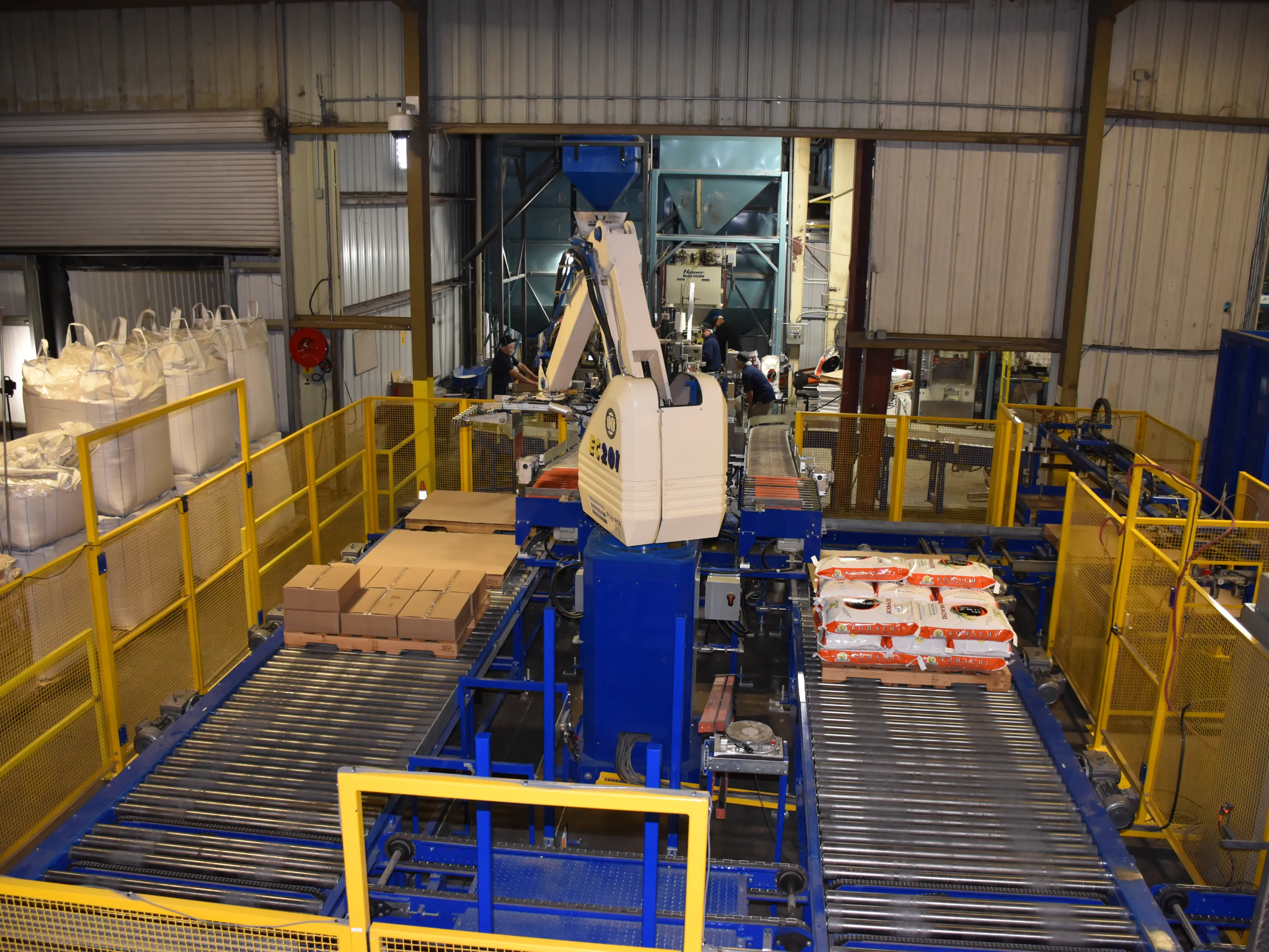
If your factory is still relying on workers to move cartons, bags or finished products onto pallets, you have probably considered automation. But one question usually comes first: how much does a robotic palletizer cost, and how long will it take to recover the investment?
There is no single price that applies to every factory. A palletizing system for a moderate-speed production line has different requirements from one handling heavy loads or operating alongside several high-speed production lines.
The more useful approach is to understand what determines the cost, calculate the savings your factory could realistically achieve, and choose a system that matches your production requirements.
Fuji Robotics offers robotic palletizing solutions for applications across industries including cement, pharmaceuticals, beverages, chemicals, paints, lubricants, dairy, animal feed and FMCG. Here is what manufacturers should consider before investing.
How Much Does a Robotic Palletizer Cost?
The cost of a robotic palletizer depends on the machine configuration and the work it needs to perform. Fuji Robotics does not publish a single standard price for every application because the requirements vary from one production line to another.
The main factors affecting the quotation include:
- Production speed: How many products must be stacked per hour?
- Product weight: Is the system handling lightweight cartons, heavy sacks or industrial containers?
- Product dimensions: Are all products the same size, or does the factory handle multiple formats?
- Number of production lines: Will one robot serve one line or several?
- Pallet handling: Will workers position empty pallets manually, or will automatic pallet conveyors be required?
- Installation and integration: Does the system need to connect with existing conveyors and other equipment?
- Safety and layout: What guarding, access arrangements and floor space are required?
These details can significantly affect the final investment. Two suppliers may quote very different prices because they are proposing different equipment and levels of integration.
The best starting point is to request a quotation based on your actual production requirements, rather than comparing machine prices without comparing specifications.
Which Fuji Robotic Palletizer Is Suitable for Your Factory?
Fuji Robotics lists four main models in its FUJI-ACE palletizing range. Each is designed for a different combination of production speed, payload and application requirements.
1. EC-102: Low to Medium-Speed Palletizing
The Fuji EC-102 robotic palletizer is designed for production lines with moderate palletizing requirements.
According to Fuji's published specifications, the EC-102 has a rated palletizing capacity of 1,200 cycles per hour, a load capacity of 160 kg including the end effector, and power requirements of 3.5 kVA.
It may be worth evaluating if your factory wants to automate palletizing without selecting a higher-speed model than the application requires.
2. EC-171: Medium to High-Speed Palletizing
The Fuji EC-171 is designed for medium- to high-speed applications. Fuji describes it as a popular model in its FUJI-ACE range, with a larger working envelope and a compact layout.
Published specifications list variants with palletizing capacities of 1,500 or 1,000 cycles per hour and load capacities of 80 kg or 160 kg, depending on configuration. The listed power requirement is 4 kVA.
This model is worth considering when production throughput, working area and product-handling requirements need to be balanced.
3. EC-202: High-Speed Palletizing
Developed through years of intensive R&D, the Fuji EC-202 represents the next generation of palletizing performance. With a wider working range, higher operating speeds and a more robust structure, it delivers superior throughput, stability and reliability to maximize production potential.
According to Fuji Robotics published specifications, the EC-202 offers a load capacity of 200 kg, including the hand gripper, and a palletizing capacity of 1,800 or more cycles per hour. It features a 4-axis configuration and a listed power consumption of 6.5 kVA.
The EC-202 is designed for demanding high-speed production environments where manufacturers require increased palletizing performance, reliable operation and efficient product handling.
Important: These are published machine specifications, not guaranteed production outputs for every factory. Fuji notes that maximum payload and maximum processing capacity do not necessarily apply simultaneously. Actual performance depends on product dimensions, weight, pallet pattern, tooling and system layout.
How to Calculate the ROI of a Robotic Palletizer
The return on investment (ROI) depends on how much the system costs and the savings it generates over time.
A practical calculation should include labour, maintenance, energy, product damage, downtime and any additional production capacity made possible by automation.
Start with the costs associated with your existing manual palletizing operation.
Step 1: Calculate Your Current Labour Cost
Record how many workers are assigned to palletizing, the number of shifts, and the total annual employment cost associated with the task.
For example, assume a factory employs four workers across its palletizing operation, with an average total employment cost of ₹25,000 per worker per month.
Annual labour cost:
4 workers × ₹25,000 × 12 months = ₹12,00,000 per year
This is an illustrative example, not a Fuji customer result or a claim that four workers will always be replaced by one robot.
Step 2: Estimate the Realistic Annual Savings
Suppose a proposed robotic palletizing system allows the factory to redeploy workers to other productive activities. If the resulting realised annual labour-cost saving is ₹9,00,000, that becomes one part of the business case.
Next, estimate any additional savings from fewer damaged products, less pallet rework, reduced downtime and improved production flow. Include only savings that can reasonably be measured.
Step 3: Deduct the Additional Operating Costs
Automation also has costs. Account for preventive maintenance, spare parts, electricity, training and any additional service or operating expenses.
For example:
- Annual labour savings: ₹9,00,000
- Other verified annual savings: ₹1,50,000
- Additional annual operating costs: ₹1,00,000
- Net annual savings: ₹9,50,000
These figures are hypothetical and are provided only to demonstrate the calculation.
Step 4: Calculate the Payback Period
Use this formula:
Payback period = Total installed investment ÷ Net annual savings
If the complete installed system costs ₹28,50,000 and net annual savings are ₹9,50,000:
₹28,50,000 ÷ ₹9,50,000 = 3 years
This means the initial investment would be recovered in approximately three years, assuming the annual savings remain consistent.
The installed investment should include all applicable costs, not just the robot itself. Conveyors, end-of-arm tooling, safety arrangements, installation, commissioning and integration can all affect the final figure.
What Other Savings Should You Consider?
Labour is only one part of the calculation. Depending on the application, a robotic palletizer may also help a factory improve:
Pallet consistency: A programmed stacking pattern can produce more consistent loads, helping reduce unstable pallets and rework.
Workplace safety: Automating repetitive lifting and stacking can reduce workers' exposure to physically demanding tasks. Appropriate guarding and safety measures are still essential.
Production flow: If manual palletizing is slowing down a packaging line, automation may help the line operate more consistently. The actual improvement depends on the bottleneck and system configuration.
Floor-space utilisation: Fuji's cylindrical-coordinate design is intended to use the working area efficiently. The final footprint depends on the selected layout, conveyors and safety arrangements.
Product flexibility: Fuji offers different end effectors for applications involving cartons, bags, bottles, boards and other products. The tooling must be selected to suit the items being handled.
Avoid assuming that every benefit will translate into cash savings. For example, redeploying workers does not automatically reduce payroll costs, and additional theoretical capacity does not generate revenue unless there is demand for the extra output.
What Information Should You Share When Requesting a Quotation?
To help a supplier recommend an appropriate system, prepare the following information:
- Product type, dimensions and weight.
- Current production rate and required pallets per hour.
- Number of production lines and operating shifts.
- Pallet dimensions, stacking pattern and required stack height.
- Available installation space and existing conveyor arrangement.
- Product variations and how frequently they change.
- Current staffing, operating costs and any known production bottlenecks.
If possible, share photographs or a short video of the current palletizing process. This can help the engineering team understand the application before proposing a configuration.
You can also review Fuji's palletizing expertise and technical specifications to understand its layouts, payloads, cycle capacities and end-effector options.
Is a Robotic Palletizer Worth the Investment?
A robotic palletizer is worth evaluating when manual stacking is creating measurable labour costs, safety concerns, inconsistent pallet quality or a production bottleneck.
However, the right decision is not necessarily to buy the fastest or heaviest machine available. It is to select a system that meets the factory's actual throughput and product-handling needs without paying for unnecessary capacity.
Calculate the full installed cost, estimate realistic annual savings and compare the expected payback period with your investment objectives. Then confirm that the proposed system can handle your products and production conditions.
Request a Robotic Palletizer Assessment
Fuji Robotics provides robotic palletizing solutions for a range of manufacturing and packaging applications. If you are considering automation, share your product details, production rate, pallet dimensions and current process requirements.
Contact the Fuji Robotics team to discuss a suitable configuration and request an application-specific quotation.
A well-planned investment starts with understanding your production line—not guessing the price of a machine.